
Roqia: In the Shadow of the Black Decade
Translated from the Russian original
Mikhail E. reviews Yanis Koussim’s Roqia (2025), reading possession as a metaphor for the trauma of Algeria’s Black Decade. He examines the cinematography, performances and a memorable scene set to Cheb Hasni.
My response to Roqia is shaped in large part by my knowledge of what Algerians went through in the 1990s. That context helps me understand Yanis Koussim’s intentions and appreciate the weight of his subject. The film has an interesting premise and a personal connection to his country’s past. Yet its execution leaves me with a sense of incompleteness.
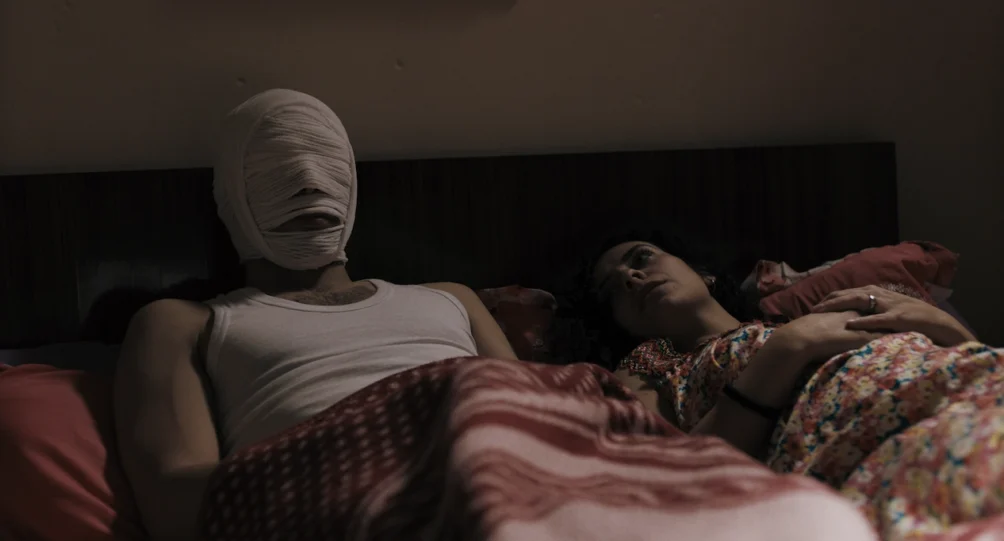
Despite its use of possession and exorcism, I do not perceive Roqia as a horror film. The trailer created expectations of the genre that the film itself did not fulfil. For me, its central meaning lies in the attempt to make sense of Algeria’s trauma of the 1990s and the ways that experience continues to affect people decades later.
I personally read the metaphor of possession as an attempt to find some measure of comfort after the trauma of the 1990s. Behind it, I see a need to believe that all that brutality and bloodshed could not have been the work of ordinary people, that a force had taken hold of them and stripped them of their humanity. It is as though this explanation offers a little distance from the most frightening realisation of all: that human beings are capable of such acts. For me, the metaphor expresses the difficulty of accepting the human origins of violence and a desire to make what happened a little more bearable.
In my view, the film relies too heavily on the knowledge its audience brings to it. Familiarity with Algeria in the 1990s helps explain the experiences behind the characters’ fears and behaviour. Without that knowledge, one can follow the events, but their historical and human weight does not fully emerge. If the film hopes to be understood beyond Algeria, it needs to offer viewers more grounding within the story itself. At present, the audience is left to do some of that work alone.
I have a positive view of the cinematography and framing. Roqia’s visual work is reasonably assured and leaves a good impression.
I also view the sound work positively overall. My reservation concerns the possession scenes: the characters’ screams at times seemed excessively loud and insufficiently integrated into the action. They gave the impression of being layered over the scene, which made these moments feel somewhat less natural.
I particularly remember the scene in the car, where the couple drives to Cheb Hasni’s music. His voice stirred feelings of nostalgia in me and fitted naturally into the film’s reflection on memory. Knowing the singer’s fate lends the scene a particular poignancy: Hasni himself was killed during the Black Decade. For me, his music here becomes a connection to that era, evoking both the everyday life that continued and the violence that could cut it short.
One of the film’s weakest aspects, for me, remains the acting. The performances often lack naturalness and emotional conviction, particularly in the dialogue scenes. Lines sound memorised, and the interactions between characters do not always make their relationships believable. This creates a distance between the audience and the characters, particularly noticeable in a story dealing with such painful human experiences. Against this backdrop, Lydia Hanni and El Hadi Douar stand out; I see undeniable acting talent in both.
I approach these shortcomings with an understanding of the difficulties facing Algerian cinema, including the limited pool of trained performers and new faces. Even so, the result depends on how much the audience believes in the people on screen, and the film lacks naturalness in this respect.
This is why, for me, an interesting idea does not come together as a sufficiently convincing whole. I understand the trauma the director is addressing and the meaning his chosen metaphor can carry. Yet the story does not develop that idea deeply enough on an emotional level. Knowledge of the context helps reveal more beneath the events, but it does not dispel the feeling that much remains insufficiently explored.
Nevertheless, I see considerable potential in Yanis Koussim. He has a subject of his own and a desire to speak about his country’s difficult past. More precise work on the screenplay, dialogue and performances, along with collaboration with strong creative and production partners, could help him express his intentions more fully. I am interested in seeing his next film.
For all my reservations, I consider Roqia a significant breakthrough for Algerian cinema. Given the conditions in which local filmmakers work, the emergence of such an ambitious film deserves respect. I hope it will inspire other creators in Algeria, give them confidence in their own stories and encourage them to explore new forms. There is courage in Roqia, and I would like to see it carried forward both in Koussim’s future work and in Algerian cinema as a whole.